In the modern world of computer graphics, turnaround speed is everything. Whether you are creating a high-end architectural visualization for a major real estate developer, developing an indie video game, or putting together a complex scene for a commercial video, creating every single object from scratch is a luxury most professionals simply cannot afford. This is exactly why the vast majority of professional 3D artists and top-tier studios actively rely on ready-made 3D models. However, sooner or later, every specialist faces the same dilemma: is it worth spending the project budget on purchasing premium assets, or is it perfectly fine to rely on the countless free databases available across the internet?
Free 3D Models: The Benefits and Hidden Risks
The main advantage of free models is glaringly obvious—they require absolutely no financial investment. There are dozens of resources online where enthusiasts and hobbyists share their personal work. This is an excellent starting point for beginners, students learning the ropes, or level designers who are putting together a greybox prototype of a scene just to evaluate the overall scale, proportions, and composition.
However, free cheese often comes in a mousetrap, and free assets have significant drawbacks. First and foremost is the quality of the topology. Free models frequently feature “dirty” geometry with an excessive number of unnecessary polygons, ngons (polygons with more than four sides), and flipped normals. Integrating such poorly constructed objects into your scene can lead to severe rendering artifacts and catastrophically slow down your software’s viewport performance. Secondly, there are often major issues with UV mapping. A free model might look fantastic on the thumbnail preview, but the moment you attempt to apply your own custom material to it, you will encounter severe texture stretching and distortion. Thirdly, the legal aspect cannot be ignored. Many free assets floating around the internet do not include clear licensing for commercial use, which could easily lead to copyright infringement issues when you deliver the final project to a paying client.
Paid 3D Models: An Investment in Efficiency
Purchasing ready-made assets on professional marketplaces is essentially a guarantee of quality. Authors who sell their work care deeply about their reputation and ratings: they ensure clean quad-based topology, create logical and non-overlapping UV unwraps, and include high-resolution PBR (Physically Based Rendering) textures.
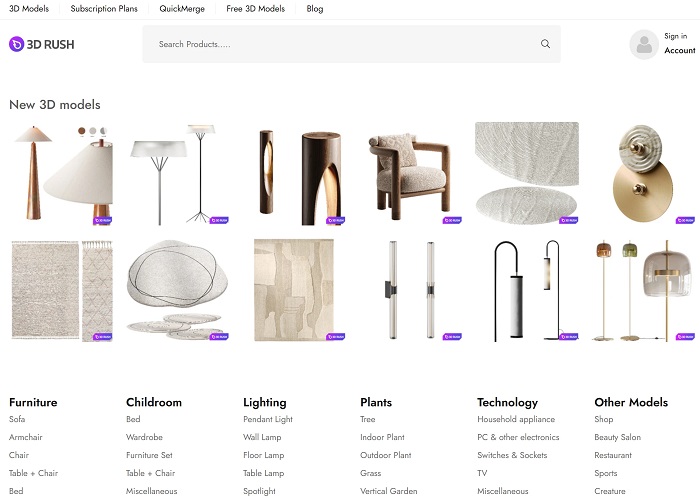
Modern and reliable platforms, such as 3D Rush, offer a massive assortment of verified and meticulously crafted models suitable for any task. The primary advantage of this approach is the colossal amount of time saved. A premium model that costs around 10 to 20 dollars can easily save you two entire days of tedious modeling work. In the grand scheme of a commercial project timeline, this small investment pays for itself instantly. Furthermore, when you purchase a model, you receive a clear, legally binding license that explicitly allows you to use the asset in commercial projects without any fear of future lawsuits or takedown notices.
How to Find the Golden Mean?
Experienced CG specialists almost always combine both approaches. For background objects, distant shots, or elements that will be heavily blurred by Depth of Field (DoF), you can safely use optimized free models or basic primitives. But for the key elements of your scene—the main characters of a game, the designer furniture in the foreground of an architectural visualization, or highly detailed machinery—you should exclusively use high-quality paid assets. When choosing a platform to source your models, pay close attention to their filtering system. A good marketplace allows you to sort objects by polygon count, file format (OBJ, FBX, MAX, BLEND), and the inclusion of PBR materials. Build your own curated library of high-quality assets, and with every new project, your workflow speed will only continue to grow.