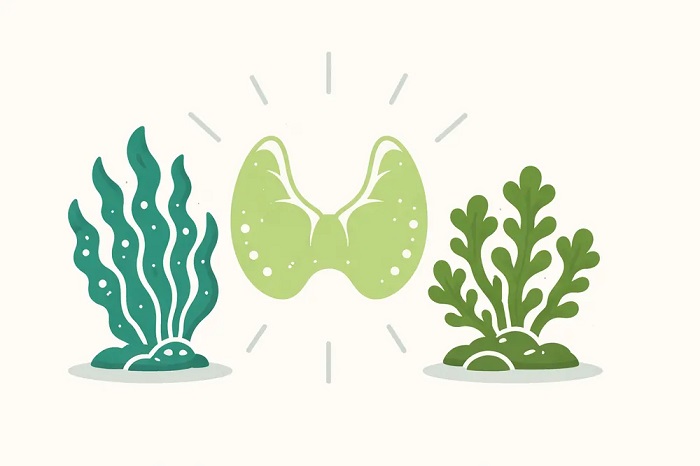
Kelp vs Seaweed for Thyroid Support is not a simple “which one is better” question. It is mostly a labeling question, an iodine-dose question, and a risk question. Many products use broad thyroid-support language, but they rarely explain that kelp is only one type of seaweed, that iodine levels can swing dramatically by species and serving size, and that more iodine is not automatically better for the thyroid. That gap between marketing and physiology is where buyers get confused.
The thyroid needs iodine to make hormones. That part is true. But thyroid support does not mean every thyroid issue is caused by low iodine, and it does not mean a kelp capsule or seaweed powder is a smart default. In iodine-sufficient populations, extra iodine may do little or may push intake too high, especially in people with Hashimoto’s thyroiditis, nodules, prior thyroid disease, pregnancy-related needs, or a habit of stacking multiple iodine sources at once.
In practice, the biggest mistake is not choosing “the wrong seaweed.” It is treating all seaweed products as nutritionally equivalent when they are not. Kombu, kelp, wakame, nori, and mixed seaweed blends can differ sharply in iodine content. A product can sound gentle and natural while still delivering several hundred or even several thousand micrograms of iodine per serving.
What is the real difference between kelp and seaweed?
Seaweed is the broad category. Kelp is a subgroup within brown seaweeds. So when a label says “seaweed for thyroid support,” that tells you less than it seems. The useful questions are these: Which species is used? How much iodine does the actual serving provide? Is that amount tested, standardized, and disclosed on the label? Without those details, the term “seaweed” works more like marketing than nutrition guidance. [oai_citation:3‡Office of Dietary Supplements](https://ods.od.nih.gov/factsheets/Iodine-HealthProfessional/?utm_source=chatgpt.com)
Kelp often gets singled out because it is naturally rich in iodine. That is exactly why it appears in thyroid-focused supplements. But the same feature that makes kelp attractive in marketing also makes it easier to overshoot a sensible daily intake. Nori and some other seaweeds can contain much less iodine than kelp or kombu. This means “seaweed” is not a dose. It is a category hiding a wide range of doses.
| Term on label | What it actually means | Why it matters for thyroid messaging |
|---|---|---|
| Seaweed | Broad umbrella term for many marine algae | Too vague to estimate iodine exposure |
| Kelp | A type of brown seaweed, often high in iodine | Can raise intake quickly, depending on species and dose |
| Blended seaweed | Mixed species, often with limited breakdown | Hard to judge consistency or risk from the front label |
| Thyroid support | Marketing phrase, not a diagnosis or treatment category | Can imply benefit without proving need or suitability |
Why does thyroid-support marketing become misleading so fast?
Because it often compresses three different ideas into one promise. First, iodine is essential for thyroid hormone production. Second, kelp and other seaweeds can provide iodine. Third, people then assume more iodine means better thyroid support. That third step is where the logic breaks. The thyroid needs enough iodine, not unlimited iodine. Both low intake and high intake can disrupt thyroid function.
The second problem is that “thyroid support” sounds universal. It is not. Hypothyroidism can have several causes. Autoimmune thyroid disease is common. In such cases, adding iodine without confirming deficiency may be unhelpful or counterproductive. Even mainstream patient guidance warns that if iodine deficiency is not the cause, iodine supplements generally do not fix hypothyroidism and too much iodine can worsen the problem.
The third problem is label theater. Front labels highlight natural sourcing, trace minerals, ocean origin, or plant-based positioning. Meanwhile, the back label may hide the only number that matters: actual iodine per daily serving. Some products also combine kelp with multivitamins, thyroid blends, or mineral complexes, which makes total iodine intake harder to see at a glance.
How much iodine does the thyroid actually need?
For most nonpregnant adults, the recommended dietary allowance is 150 mcg per day. Needs rise in pregnancy and lactation. In the United States, the adult tolerable upper intake level is 1,100 mcg per day. In Europe, the adult upper level commonly referenced by EFSA is lower, at 600 mcg per day. That gap alone shows why “high iodine” should not be marketed casually as routine wellness support.
Now compare those targets with real-world seaweed products. One study of commercially available macroalgae foods and supplements found iodine ranged from 30 to 25,300 mcg per portion in macroalgae-containing foods and from 5 to 5,600 mcg per daily dose in supplements. That range is the entire story in one statistic. A seaweed product may be modest, or it may massively overshoot a daily target.
Quick stats that matter
- Adult iodine RDA: 150 mcg/day
- Pregnancy RDA: 220 mcg/day
- Lactation RDA: 290 mcg/day
- Adult UL in the U.S.: 1,100 mcg/day
- Commercial seaweed supplements studied: 5 to 5,600 mcg iodine per daily dose
Which is more predictable for thyroid support: kelp or generic seaweed?
Neither is predictable unless the product discloses tested iodine content. Kelp is often more iodine-dense than many other edible seaweeds, but “generic seaweed” on a label can still hide a high-iodine species or an inconsistent blend. The better question is not kelp versus seaweed. It is tested iodine versus guessed iodine.
That is why species identity matters. Kombu and kelp are often the highest-risk examples for very high iodine exposure. Nori is often lower. Wakame sits somewhere in between, depending on source and preparation. A front label that says only “ocean vegetables” tells you almost nothing useful for thyroid decision-making.
| Product style | Main strength | Main limitation | Bottom-line thyroid take |
|---|---|---|---|
| Kelp supplement | Often concentrated iodine source | Easier to overshoot intake | Needs clear iodine disclosure and caution |
| Whole seaweed food | Provides food matrix and culinary flexibility | Iodine still varies widely by species and portion | Food form is not automatically low-risk |
| Mixed seaweed blend | Broad nutrient story for marketing | Poor dose clarity if species are not broken out | Hard to judge from branding alone |
| Standardized iodine supplement | More predictable dose on paper | Still may be unnecessary without confirmed need | Better for dose control, not for self-diagnosis |
Who should be especially careful with kelp and seaweed products?
Anyone with known thyroid disease should slow down before adding high-iodine supplements. The same applies to people who are pregnant, breastfeeding, older, or already using iodine-containing multivitamins, sea moss products, electrolyte blends, or “metabolism” formulas. The American Thyroid Association has warned against iodine and kelp supplements containing more than 500 mcg iodine daily, especially because some products provide several times more than that.
People also forget about cumulative intake. A breakfast multivitamin, sushi dinner, seaweed snack, and a kelp capsule can stack faster than expected. This is why the safest buying habit is arithmetic, not optimism. Add the actual labeled iodine from all sources before assuming a product is gentle.
What does the evidence say about whole seaweed and thyroid outcomes?
Whole seaweed is nutritionally interesting. It can provide fiber, minerals, and bioactive compounds. But human evidence for broad health effects is still mixed, and thyroid interpretation is complicated by species differences, iodine variability, preparation methods, and baseline iodine status of the population studied. A 2023 review concluded that human intervention evidence remains limited and methods across studies are inconsistent. So the wellness halo around seaweed is often stronger than the clinical evidence behind it.
Recent work on habitual seaweed consumers also supports caution. In that study, stopping seaweed intake lowered TSH significantly, which suggests that regular high-iodine seaweed intake can affect thyroid physiology in some users. That does not mean seaweed is bad. It means the thyroid notices iodine exposure, and not everyone responds the same way.
How can you read a thyroid-support label more intelligently?
Use this checklist before you buy:
- Check whether the label lists actual iodine in mcg per serving.
- Look for the exact seaweed species, not just “seaweed” or “marine blend.”
- Add iodine from your multivitamin, prenatal, salt habits, seafood, and snacks.
- Be cautious with products above 500 mcg/day unless a clinician advised it.
- Avoid assuming “natural” means low dose or low risk.
- Be extra careful if you have Hashimoto’s, nodules, or prior thyroid disease.
What is the practical takeaway for beginners?
If your goal is thyroid support, stop thinking in brand slogans and start thinking in iodine numbers. Kelp is not automatically better than seaweed. Seaweed is not automatically gentler than kelp. The most reliable product is the one that clearly states the species, clearly states the iodine dose, and fits a real need rather than a vague fear about the thyroid.
For many beginners, the most misleading part of the category is the phrase “supports thyroid health” itself. It sounds precise, but it usually skips the two facts that matter most: whether you actually need more iodine and how much iodine the product truly delivers.
Kelp vs Seaweed for Thyroid Support | FAQ
Is kelp the same thing as seaweed?
No. Kelp is one type of brown seaweed. “Seaweed” is the broader category.
Does more iodine always mean better thyroid support?
No. The thyroid needs adequate iodine, but too much iodine can also disrupt thyroid function.
Are kelp supplements safer than whole seaweed foods?
Not automatically. Safety depends on species, serving size, and actual iodine per serving.
Can iodine supplements help every case of hypothyroidism?
No. If iodine deficiency is not the cause, iodine supplements usually do not solve the problem.
Why do labels that say “seaweed” feel vague?
Because iodine varies sharply across seaweed species, so the generic term hides dose differences.
What number should make buyers pause?
Anything that pushes intake high, especially products above 500 mcg iodine per day without a clear reason.
Glossary
Iodine
An essential mineral the thyroid uses to make hormones.
Thyroid hormones
Mainly T4 and T3, hormones that help regulate metabolism and development.
Kelp
A group of brown seaweeds often high in iodine.
Seaweed
A broad term for edible marine algae, including brown, red, and green types.
RDA
Recommended Dietary Allowance, the daily intake target for most healthy people.
UL
Tolerable Upper Intake Level, the daily intake unlikely to cause harm in most people.
TSH
Thyroid-stimulating hormone, a common lab marker used to assess thyroid regulation.
Hashimoto’s thyroiditis
An autoimmune thyroid disorder and a common cause of hypothyroidism.
Macroalgae
The scientific term often used for larger seaweeds in foods and supplements.
Conclusion
Kelp versus seaweed is mostly a labeling shortcut, not a useful thyroid answer. For thyroid support, the real filter is simple: know the species, know the iodine dose, and do not let marketing replace physiology.
Used Sources
- NIH Office of Dietary Supplements, health professional fact sheet on iodine: intake targets, seaweed as a source, and risks of excess. ods.od.nih.gov/factsheets/Iodine-HealthProfessional/
- NIH Office of Dietary Supplements, consumer iodine fact sheet: adult and pregnancy intake guidance. ods.od.nih.gov/factsheets/Iodine-Consumer/
- American Thyroid Association statement on excess iodine exposure: caution on iodine and kelp supplements above 500 mcg/day. thyroid.org/ata-statement-on-the-potential-risks-of-excess-iodine-ingestion-and-exposure/
- Leung et al., Thyroid statement on excess iodine and thyroid dysfunction risk. pubmed.ncbi.nlm.nih.gov/25275241/
- Aakre et al., study of commercially available kelp and seaweed products: very wide iodine range across foods and supplements. pmc.ncbi.nlm.nih.gov/articles/PMC8035890/
- Frontiers in Nutrition review on whole seaweed consumption in humans: promising area, but limited and mixed intervention evidence. frontiersin.org/journals/nutrition/articles/10.3389/fnut.2023.1226168/full
- National Academies chapter on iodine: U.S. adult upper intake level of 1,100 mcg/day. nationalacademies.org/read/10026/chapter/10
- EFSA reference on iodine dietary values and European upper level context. efsa.europa.eu/sites/default/files/consultation/140115.pdf
- Mayo Clinic patient guidance on hypothyroidism and iodine supplements: extra iodine does not help if deficiency is not the cause. mayoclinic.org/diseases-conditions/hypothyroidism/expert-answers/hypothyroidism-iodine/faq-20057929
- CDC and NHANES references on iodine status: general U.S. population remains iodine sufficient overall, with some vulnerable groups. cdc.gov/nchs/data/hestat/iodine.htm and wwn.cdc.gov/Nchs/Data/Nhanes/Public/2019/DataFiles/IODS_K_R.htm
- Recent study on habitual seaweed consumption and thyroid markers: regular intake can affect TSH. pmc.ncbi.nlm.nih.gov/articles/PMC12811364/