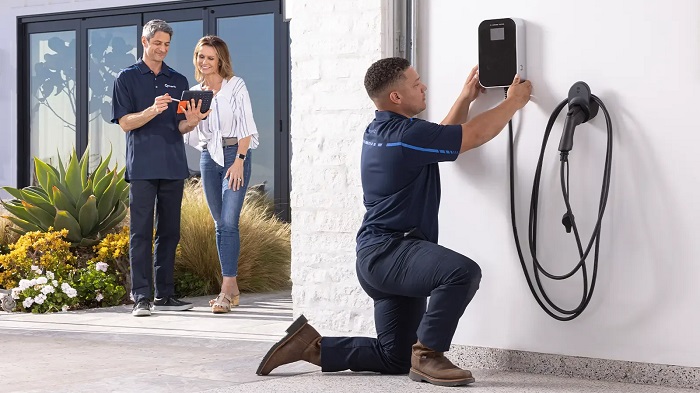
EV charging changes the shape of an electric bill. A home that once had modest evening loads may suddenly add a large overnight charger. A workplace that installs chargers for employees or customers may create new peaks during business hours.
Why Storage Enters the EV Conversation
Energy storage can help manage when and how EV charging draws power. A battery may store solar energy during the day, charge from the grid during lower-cost periods, or reduce peak demand when several vehicles charge at once.
For a home, this can mean charging an EV without using as much expensive evening grid power. For a business, it can mean offering EV charging without creating painful demand spikes.
The International Energy Agency’s 2026 vehicle-to-grid analysis notes that smart and bidirectional charging can help reduce peak demand and support grid flexibility.
Home Charging: Solar, Battery, EV
At home, the challenge is timing. Solar panels often produce the most power while the car is away. A stationary battery can capture some of that energy and make it available later.
If the EV supports bidirectional charging, vehicle-to-home technology may allow the car to send power back to the house. That can be useful during outages, but it depends on compatible vehicles, chargers, codes, and utility rules.
ESYsunhome lists EV22 V2E as a 22 kW charger that is V2H/V2G ready, alongside home storage and smart energy products. Readers comparing solar, batteries, and EV charging as one system can start with ESYsunhome.com.
Workplace Charging: Peaks Matter
For workplaces, EV charging can become a demand-charge issue. If several chargers run at the same time as HVAC, lighting, refrigeration, or production equipment, the facility’s grid draw may jump.
A battery can discharge during those charging peaks. It can also store solar energy from a rooftop or carport system and use it later for vehicles.
This does not eliminate the need for electrical planning. Charger count, charging speed, transformer capacity, parking patterns, and utility tariffs all matter.
Managed Charging Comes First
Battery storage is powerful, but it should not be the only tool. Managed charging can schedule or limit charging based on building load, electricity price, or vehicle dwell time.
A battery then adds flexibility. It can smooth the remaining peaks and provide backup for selected loads.
Bidirectional Charging Is Promising, Not Automatic
V2H and V2G are becoming more visible, but they are not universal features. The EV, charger, home electrical setup, utility program, and software all need to support the use case.
That is why stationary storage still has a role. The home or workplace battery is always connected and available, while the EV may be away or low on charge.
Plan Charging as Part of the Building
EV charging should not be treated as an accessory. It affects energy use, solar value, backup planning, and demand charges.
The smartest projects design solar, storage, chargers, and controls together. That makes EV charging easier to scale without surprising the electric bill.