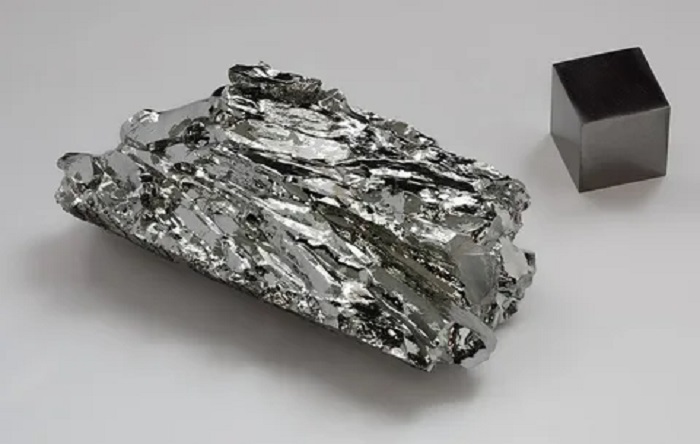
Metallic molybdenum is a refractory transition metal characterized by a high melting point and excellent creep resistance, making it highly sought after for applications involving extreme thermal and mechanical stress. In industry, it serves as an alloying element to enhance the strength and corrosion resistance of steels and alloys; it is also used to manufacture components designed for high-temperature operation within vacuum or inert environments.
Due to its combination of thermal conductivity, dimensional stability, and chemical resistance, metallic molybdenum is employed in electrical engineering, vacuum technology, and instrumentation—for instance, in heating elements, heat shields, and structural components for furnaces. In various high-temperature and functional materials, molybdenum is used in combination with other rare or refractory metals—such as yttrium—to fine-tune the properties of an alloy for specific technical requirements.
What is metallic molybdenum?
In industrial practice, “metallic molybdenum” generally refers to material produced via powder metallurgy, involving consolidation (pressing/sintering) and/or mechanical processing (rolling, forging, or drawing). The specific production method determines the grain structure, the level of residual porosity, and the distribution of impurities—all of which, in turn, dictate the material’s technical and operational characteristics.
Structure and microstructure
Under standard conditions, the crystal lattice of molybdenum has a body-centered cubic (BCC) structure. This type of crystal lattice is characteristic of a number of refractory metals; it accounts for the combination of a high melting point and stable properties at elevated temperatures, while also increasing susceptibility to brittle fracture at low temperatures or in the presence of deleterious impurities.
The structure of metallic molybdenum is defined not only by its lattice type but also by microstructural parameters, including grain size, rolling texture, the presence of subgrains and dislocations, and residual inclusions. For manufactured products—such as sheets, wire, or rods—the direction of deformation and subsequent heat treatment are critical; these factors influence anisotropy (the variation of properties depending on direction), ductility, and resistance to thermal cycling.
Purity and Grades of Metallic Molybdenum
The purity of metallic molybdenum is a key metric, as even trace amounts of certain elements can drastically alter the metal’s behavior during processing and service. Impurities such as oxygen, nitrogen, carbon, and sulfur are particularly critical: they can increase brittleness, impair weldability, and reduce ductility during cold deformation. Consequently, high-purity molybdenum is used for demanding applications, with quality control monitored both through the total impurity content and through specific, regulated limits for individual elements.
In practical materials science, several quality grades of metallic molybdenum are recognized: technical-grade, high-purity, and ultra-high-purity. Higher purity ensures greater stability of properties at elevated temperatures and more predictable outcomes during rolling, wire drawing, and vacuum heat treatment; however, it also imposes stricter requirements on the starting powders, the sintering atmosphere, and the cleanliness of the processing equipment. Molybdenum grades are typically defined by a set of requirements concerning chemical composition, mechanical properties, and delivery condition (sintered, worked, or recrystallized). In practice, the following types are encountered:
- pure (unalloyed) molybdenum – the standard choice for furnace components, heat shields, and current-carrying elements;
- alloyed grades (e.g., containing minor additives to enhance high-temperature strength and creep resistance) – used in applications where dimensional stability during prolonged heating is critical;
- molybdenum tailored for specific requirements – featuring restricted impurity levels or a defined microstructure (such as fine grain size or controlled texture) to suit particular processing conditions.
When selecting a grade, one must consider not only the molybdenum content but also the intended operating environment—such as whether the material will be exposed to a vacuum or an oxidizing atmosphere—as well as the nature of the mechanical loading (static versus thermal cycling) and whether high ductility is required for subsequent forming operations. Ultimately, it is the combination of microstructure, purity, and grade-specific requirements that determines whether metallic molybdenum will serve as a reliable structural material for high-temperature components.